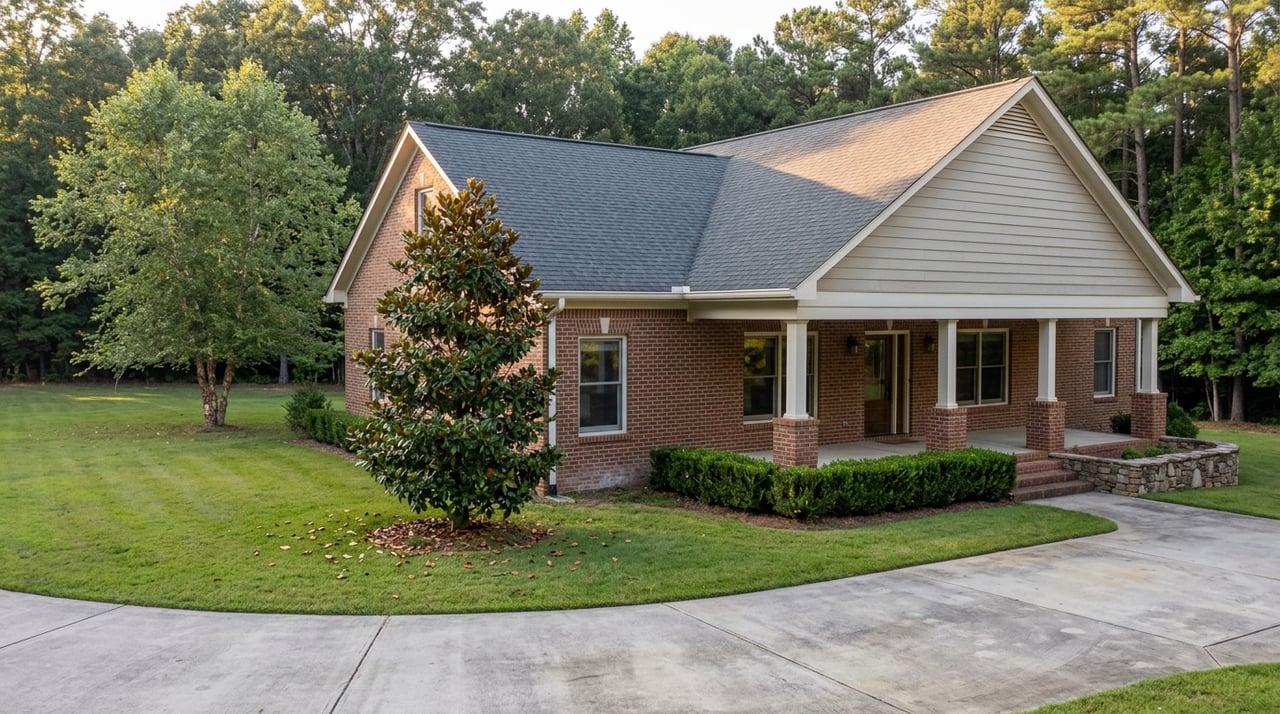
In Hudson, the Bedroom Count on Your Septic Permit Outranks the One on Your Listing
September 24, 2026
September 24, 2026
A four-bedroom house in Hudson does not automatically sell as a four-bedroom house. If that home runs on a septic system, the number that actually controls the listing lives in a file at the Caldwell County Health Department, not in the floor plan. When those two numbers disagree, the permit wins, and the disagreement tends to surface at the worst possible moment: after an offer, sometimes after closing.
This matters more in Hudson than it does in a lot of neighboring towns, and the reason has nothing to do with soil or rainfall. It has to do with how Hudson gets its water and sewer service in the first place.
Hudson does not run its own water and sewer utility. Under a long-standing agreement between the Town of Hudson and the City of Lenoir, Lenoir provides water and sewer service to Hudson residents and businesses, and Lenoir handles the billing. That arrangement works well for the parts of town the pipe network already reaches. It leaves everything else outside it.
Because that coverage follows infrastructure built out over decades rather than the town's current boundary lines, plenty of addresses with a Hudson mailing address sit beyond the reach of that agreement. Acreage tracts off US 321A, lots near Caldwell Community College and Redwood Park, and parcels on the quieter dead-end roads that show up throughout Hudson's current land listings tend to fall into this category. Several of those active listings say so directly, flagging that a perc test or a buyer-verified survey is needed before anyone can assume the property is buildable as described.
None of this makes Hudson unusual for western North Carolina. It does mean a Hudson seller cannot assume city sewer just because the house sits inside town limits, and a Hudson buyer cannot assume a lot will support the home they are picturing just because a similar house sits down the road.
North Carolina's septic rules are administered locally, and in Caldwell County that means the Central Permitting Office within the Health Department, which handles the lot evaluation, issues the Improvement Permit, and later signs off once the system is installed and inspected. The Improvement Permit application currently carries a fee that covers the site visit, the soil evaluation, and the layout of the proposed system.
The design standard behind that permit is not casual. North Carolina Real Estate Commission guidance figures wastewater capacity at two people per bedroom listed on the permit, not two people per bedroom someone happens to be sleeping in. A system permitted for three bedrooms is engineered, sized, and approved for three bedrooms. Turning a bonus room into a fourth bedroom does not change the permit. It just changes whether the house is legally accurate as advertised.
Setbacks matter too. A pool, a garage, or an addition planned without checking the improvement permit's site plan can end up sitting on top of the repair area the system is depending on if the original drain field ever fails.
Before relying on an older permit, confirm its status with Caldwell County.
The North Carolina Real Estate Commission has published guidance on this exact problem for decades, because it keeps happening. The pattern shows up in the Commission's own disciplinary record: a home advertised with more bedrooms than its septic permit allowed, a buyer who planned to finish a bedroom and was never told to verify capacity first, a listing that assumed public sewer without confirming it and turned out to be on a septic tank the whole time.
In each type of case, the fallout landed on the buyer after closing, not before. A system permitted for three bedrooms but marketed as five means the new owner either lives with fewer usable bedrooms than they paid for or pays to expand a system that may not have room to expand. The Commission's own advice is blunt about where to look for the answer: not tax records, which are unreliable on this point, but the actual permit on file with the county.
| Property type in Hudson | Likely water/sewer setup | What to check before listing or offering |
|---|---|---|
| In-town home on an older street near the Lenoir service lines | City of Lenoir water and sewer | Confirm connection directly with Lenoir billing, don't assume from the address alone |
| Edge-of-town home built before recent line extensions | Could be either | Ask the seller for proof of connection or a septic permit, don't guess |
| Acreage or rural-fringe lot off 321A or on a dead-end road | Private well and septic | Pull the Improvement Permit and compare its bedroom count to the current or planned floor plan |
| Land listed as build-ready | Depends on whether a valid permit already exists | Verify the permit is for the home actually planned, not just any home |
Hudson's current land and home inventory leans toward exactly the kind of properties where this matters most. Multiple active listings for acreage in and around town explicitly note that a perc test is required or that a buyer should verify septic suitability before closing. That is not a red flag on any single one of those properties. It is a sign that septic verification is a normal, expected step in how Hudson real estate actually transacts, not an edge case.
Does adding a bathroom count the same as adding a bedroom? Not necessarily. Septic capacity is calculated around bedrooms because that number drives expected occupancy, so a bathroom addition without a new bedroom usually doesn't change the permitted count. A finished room that could function as a bedroom is where the question gets murkier, and it is worth a direct conversation with the county rather than an assumption either way.
What if the house has always had more bedrooms than the permit allows, and nobody noticed for years? It happens, often because tax records and MLS history simply repeated an earlier mistake. The fix is the same regardless of how long it went unnoticed: confirm the actual permitted capacity before the next listing goes live, and correct the advertised bedroom count if it doesn't match.
A septic permit is not the most exciting document in a real estate transaction, but in Hudson it is often the one that decides whether a sale goes smoothly or turns into a renegotiation after closing. Julian Baker's background in construction and neighborhood development means Baker Realty is used to reading permits and site plans as part of pricing a property honestly, not as an afterthought. If you are getting ready to list a home in Hudson, or you are looking at acreage along 321A and want to know what you are actually buying, Baker Realty's Hudson team can walk the permit history with you before it becomes a surprise. You can also start with a straightforward home valuation to see where your property stands once the paperwork is sorted out.
This article is general information, not legal, tax or financial advice. Consult a qualified professional about your situation.
Stay up to date on the latest real estate trends.
Etiam non quam lacus suspendisse faucibus interdum. Orci ac auctor augue mauris augue neque. Bibendum at varius vel pharetra. Viverra orci sagittis eu volutpat.